As awareness of sustainable energy increases, solar panels are one of the most well known technologies in the clean energy revolution. But how do solar panels convert sunlight to usable electricity? This topic can seem complex, but if we take the time to break it down, it will reveal a wonderful blend of nature and technology.
Contents
What are solar panels made of?
At its most basic level, solar panels are well-designed technology which converts sunlight into usable electricity.
Photovoltaic cells
At the center of any solar panel are photovoltaic (PV) cells, which are made of silicon – one of the most common and abundant, and semiconductive materials on the planet. Each PV cell is comprised of a positive layer and a negative layer, so that it creates an electric field, similar to a battery.
When light strikes a PV cell, photons knock electrons loose so that there can be an electric current created. This is the scientific principle which allows every solar system to work.
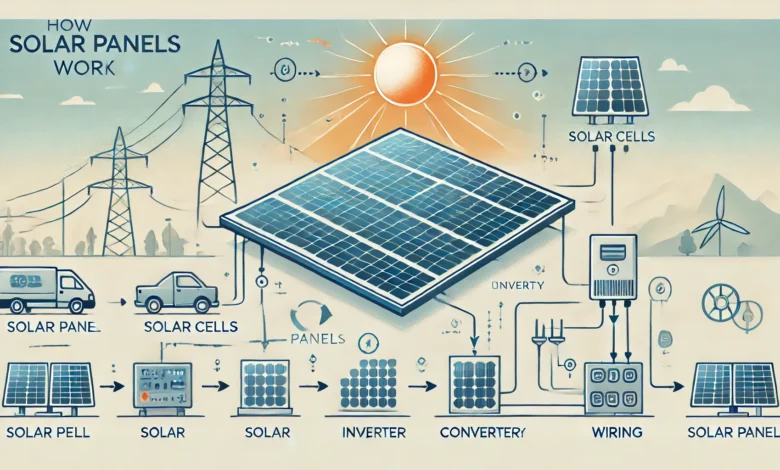
Other parts of a solar panel
What else is in a solar panel? A typical solar panel has other parts besides PV cells, including:
- Glass casing – protects the cells from the elements.
- Backsheet – adds insulation and structural durability to the panel.
- Metal frame – provides support.
- Wiring – safely carries the power from the PV cells to the inverter.
If you want to learn some more about different construction types of panels, check out our article Types of Solar Panels.
How do solar panels turn sunlight into electricity?
When we think about the process of turning sunlight into usable electricity, we appreciate how simple and elegant solar power is.
The photovoltaic effect
The photovoltaic effect is how solar cells convert sunlight into electricity. Here’s an uncomplicated summary:
- Sunlight enters the surface of the solar panel for absorption.
- The light [or solar] energy’s photons excite the electrons in the photovoltaic (PV) cells.
- Electrons in which energy is added them start to flow, which creates a direct current (DC).
French physicist Alexandre Edmond Becquerel observed this effect (electromagnetic energy) back in 1839 – (this “effect” would later power millions of homes).
Direct Current (DC) vs. Alternating Current (AC)
Solar panels naturally create direct current (DC) electricity. Your home or business uses alternating current (AC).
When the electricity from the panels goes to an inverter, it converts the DC electricity from the solar panels into usable AC electricity.
More recent systems now use a microinverter on every panel to maximize the useable electricity produced by panels in instances of partial shading of the panel’s surface area.
Types of Solar Panels and How They Work
The surface of the solar panel is not just one type of surface – often referred to as ‘solar panels’ each type is creatively designed to serve a different purpose.
Monocrystalline Solar Panels
- Made from a single continuous crystal structure.
- Highest efficiency (up to 23%).
- Attractive black appearance, popular for rooftop installations on residences.
Polycrystalline Solar Panels
- Made from multiple crystals of silicon.
- Slightly less efficiency (approximately 15–17%).
- Also a cost-effective option for larger installations.
Thin-Film Solar Panels
- Made with a variety of materials; including cadmium telluride.
- Lightweight and bendable.
- Less efficiency than crystalline panels; however maybe ideal for some unique projects such as portable panels or surfaces requiring a curved surface.
Wondering how to choose the right panel for your project? If you want to find out more about Monocrystalline Vs Polycrystalline Solar Panels visit our guide to help you decide.
What Affects Solar Panel Efficiency
Even the best technology relies heavily on environmental factors.
Sunlight Dependence
Naturally, the amount of power a panel can generate is reliant on how much sunlight is available. For example, the more direct sunlight a solar panel receives, the more electricity it will produce. Areas that are closer to the equator or have sunny weather like California or Nevada are optimal for achieving the best output.
Temperature and Other Weather
Interestingly, however, extremely hot temperatures can have an adverse effect on a solar panel’s efficiency. Specifically, photovoltaic panels are actually most efficient near 25°C (77°F). Cloudy days or heavy snow can reduce electricity production, but will not completely eliminate energy production.
Tilt and Orientation
Solar panels need to be tilted the correct way to match the sun’s path to produce optimal energy generation. In the U.S. the general angle rules is that you can safely tilt your panels approximately the same angle as your latitude.
In a south facing installation, you expect to yield the most solar output.
Most solar professionals will perform an extensive analysis of a site before finalizing the recommendations on the solar panel installation to maximize performance.
What is the future of solar panel technology going into 2025 and beyond?
The solar industry is experiencing rapid innovation.
In its 2025 report, the International Energy Agency (IEA) projects that:
- Solar energy will account for over 60% of new global renewable capacity installations.
- There will be new discoveries like perovskite solar cells that produce cheaper, lighter, more efficient panels.
- There will be new integrations with smart grids and energy storage systems that will become standard when producing, storing, and managing energy.
The transition of floating solar farms and building-integrated solar (like solar glass windows) from the experimental phase to deployment is also happening at breakneck speed.
As technology matures, it is getting increasingly easier for homeowners and every day businesses to not just generate and use clean power, but to also set up systems to collectively store, manage and optimize their collective renewable energy use.
Staring upwards at a sleek, glimmering array of panels, some homeowners realize they were not merely saving money that month on their power bill — they were actively participating in reshaping the world’s energy future.
Frequently Asked Questions (FAQ)
How much electricity does a solar panel produce per day?
On average, with a standard residential solar panel, you can expect to generate power that is equivalent to between 1.5kWh and 2.5kWh per day, depending on available sunlight and latitude.
What do solar panels do on cloudy days?
Solar panels still produce electricity when it is cloudy, but it will output significantly less than its rated capacity, typically around 10–25%.
Do solar panels completely power a house?
Yes, a properly sized solar system can completely power a household’s energy use, and be complemented with home battery storage if needed.
How long does it take to pay for itself?
Typically, most systems will pay back in around 6 to 10 years, on average, depending on power prices, rebates/incentives and energy usage.
Are solar panels environmentally friendly?
Though the manufacturing of a solar panel has a certain amount of environmental damage, the life-cycle emissions of solar panels are significantly lower than fossil fuels so they are one of the cleanest energy sources available.